When a piano hasn't been tuned for a long time, it isn't just single notes that go out — the whole instrument drops. The strings slowly lose tension, and after a few years A4 sounds at, say, 432 Hz instead of 440. Such a piano is called flat. Here is what to do about it.
How to tell the pitch has dropped
Compare A4 with a 440 Hz reference or play along with a recording. If the piano is clearly lower, its pitch has dropped. A tuner shows it precisely: almost every note is flat, on average by more than 15 cents.
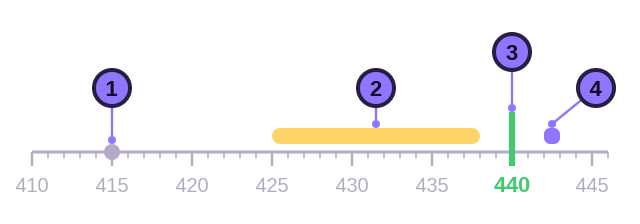
- 415 Hz — early (Baroque) music.
- 425–438 Hz — how a piano that hasn't been tuned for a long time often sounds.
- 440 Hz — the international standard.
- 442–443 Hz — many orchestras and concert halls.
Option one: tune it to itself
You don't have to bring the piano back to 440 Hz. You can take its current level — say A4 = 434 Hz — and tune every note from that. The piano will sound clean, just slightly below standard. If you play solo nobody will notice, and an old instrument takes no extra load.
This doesn't work if you play with a violin, flute or guitar, or along with recordings: then you need the same pitch as them.
Option two: a pitch raise to 440 Hz
You can't simply tune it to 440. The total tension of a piano's strings is about 18–20 tonnes. As the tension of hundreds of strings rises, the frame and soundboard give a little, and the notes you already tuned drop. So the pitch is raised in two stages.
1. A rough pass with overpull
Each note is set slightly above its target — by a share of how flat it was. If a note was 20 cents flat, it goes about 5 cents sharp (25% overpull). As you work across the keyboard, the frame settles and the notes come down to pitch by themselves.
- Start with about 25% overpull: a little less in the bass, more in the treble.
- Work quickly: ±3–5 cents is accurate enough.
- After the pass, check 10–15 notes. If they are still clearly flat, overpull more next time; if sharp, less. Every piano gives differently.
2. The fine tuning
Right after the rough pass, a normal tuning in two passes: from A4 up, then down, then the whole instrument once more. How that's done: "How to tune a piano yourself".
When to raise it in two stages
| How far below standard | What to do |
|---|---|
| Up to −15 cents | A normal tuning, no raise needed |
| −15 … −50 cents | A pitch raise with overpull, then a fine tuning |
| More than −50 cents | Two stages: first to an intermediate pitch (say A4 = 438 Hz), 1–2 weeks later to 440 |
| Below −40 cents with old strings | Better call a technician |
Careful: old and rusty strings break during a pitch raise. Wear glasses and don't pull a note up by more than 50 cents at a time. If a pin turns too easily, stop — that's a repair.
How the app does it
In Foxtune: Piano Tuner the pitch raise is a step of the plan. From the survey the app computes the overpull for every note, shows the target with overpull right on the tuner, and after the pass refines the percentage for your piano from a few notes. If notes need to go up by more than 50 cents, it warns you and splits the raise into two stages.
Related: tuning an old piano.