You can tune a piano yourself. You need a tuning lever, a couple of rubber mutes, a tuner that understands pianos and a few free hours. Below is the order of work we use ourselves — and the one the Foxtune: Piano Tuner app walks you through.
Should you tune it yourself?
Yes, if the instrument is basically sound. Don't pick up the lever if:
- the piano is far below pitch: A4 is under 430 Hz, more than 40 cents flat. It needs a pitch raise first, and that is better done with a technician;
- a tuning pin turns too easily, clicks or creeps back on its own: the pinblock is worn;
- the strings are rusty: they break more often;
- a string is broken or a key sticks: that's a repair, not a tuning.
Wear glasses: a breaking string can whip.
What you need
- A tuning lever (tuning hammer) with a star tip, which fits the pins of most uprights and grands. Pliers and spanners won't do: they crush the pin and it stops holding. How to choose a lever and mutes: "Piano tuning lever and mutes".
- 2–3 rubber mutes so that only one string sounds.
- A piano tuner. A chromatic tuner pulls every note to its "mathematical" pitch, and that's not how pianos are tuned (more below).
- A torch: it's dark inside a piano.
- Quiet. A TV, talking or a washing machine all get in the way of the measurement.
Step 1. Check how far it has drifted
Before you pick up the lever, find out what state the instrument is in. Play two notes in every octave and see how many cents each one is off. That shows whether single notes have drifted apart or the whole piano has dropped.
In the app this is the "Tuning survey": five minutes, no lever needed. You play keys one at a time and the app shows a chart of all 88 keys with a plain verdict.
Step 2. Choose the pitch
Every note is tuned from A4, the A above middle C. The standard is 440 Hz.
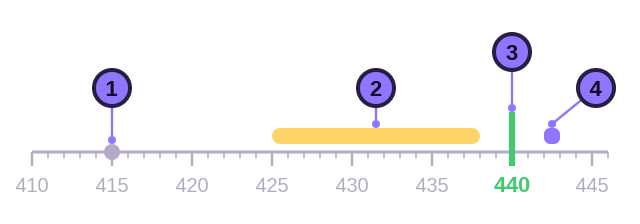
- 415 Hz — early (Baroque) music.
- 425–438 Hz — how a piano that hasn't been tuned for a long time often sounds: the pitch has sagged.
- 440 Hz — the international standard. Use it if the instrument holds its tuning.
- 442–443 Hz — many orchestras and concert halls.
If the piano has sagged, pulling every string up to 440 Hz in one go is risky: the tension grows by hundreds of kilograms, old strings may break and the tuning won't hold. It's safer to tune the piano to itself at its current level: it will sound clean, just slightly below standard. If you need 440 exactly, read "Pitch raise".
Step 3. Open the piano
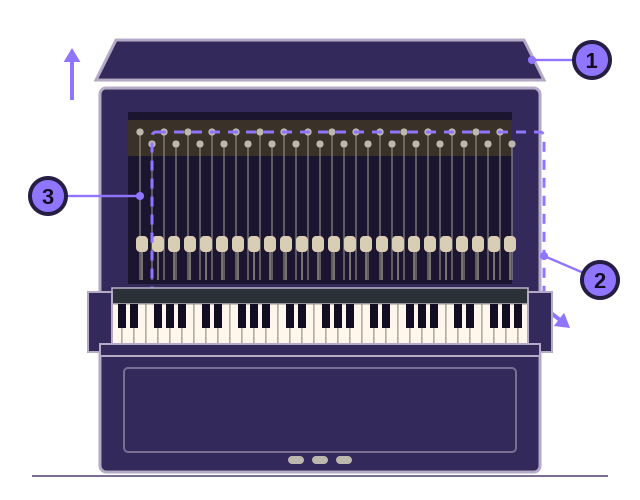
- Raise the top lid. Take off anything standing on it.
- Take off the upper front panel. It is held by latches or swivel catches on the sides — you can see them from inside once the lid is up. Turn them, tilt the panel towards you and lift it out.
- Behind the panel are the tuning pins and strings. This is where you will work.
On a grand it's simpler: open the lid and take out the music desk; the pins are right above the keyboard.
Step 4. Know what to turn
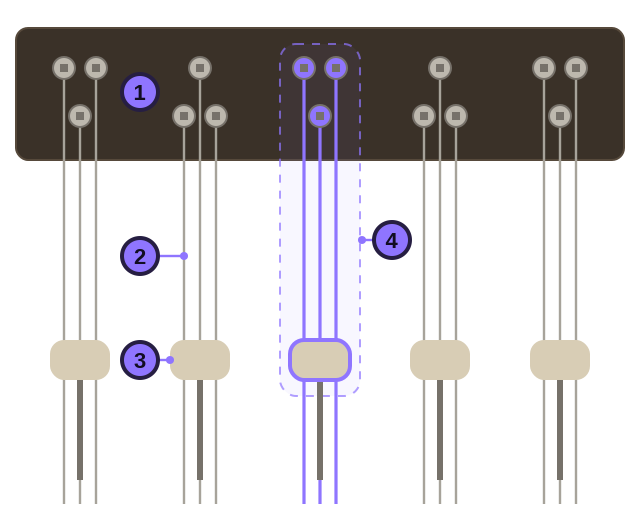
- Tuning pins — steel pins in the wooden pinblock. Each one holds one string. These are what you turn with the lever.
- Strings. In the middle of the keyboard each key has 3 strings, towards the bass 2, and in the deep bass a single thick copper-wound one.
- Hammers. Press a key and its hammer strikes the strings of that note. Leave the hammers and the felt parts around them alone.
- A unison — all the strings of one key together.
To find the pin of a string, press the key slowly and watch which hammer moves. Follow its strings upwards: each one ends at its own pin.
The main rule: turn the lever — strike the key — look at the tuner. If the pitch didn't change, you are turning the wrong pin. Put the lever back where it was at once.
Step 5. How to hold the lever
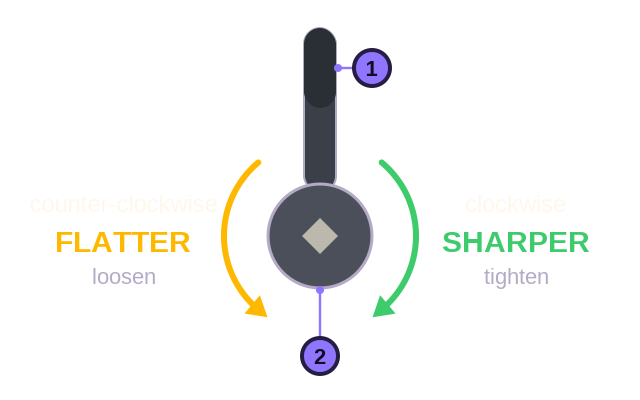
- The handle. Hold it roughly upright, "at 12–1 o'clock". Then moving the handle right turns the pin clockwise (sharper), and left counter-clockwise (flatter).
- The head. Push it onto the pin all the way: it must sit tight, without play.
- The movements are tiny. The pin turns a degree or two, and that's already enough to move the note by several cents.
- Don't push sideways. The pin bends and the tuning drifts later. Turn, don't rock.
- Approach the note from below. If you overshoot, drop the note 10–20 cents below and bring it up to zero again. That way the pin sets firmly and holds.
- Strike the key firmly and loudly. A strong blow evens out the tension along the whole string, and the tuning lasts longer.
Step 6. One string at a time
If three strings sound at once, the tuner hears their mix and can't show each one. So the others are muted with a rubber wedge and the strings are tuned one by one.
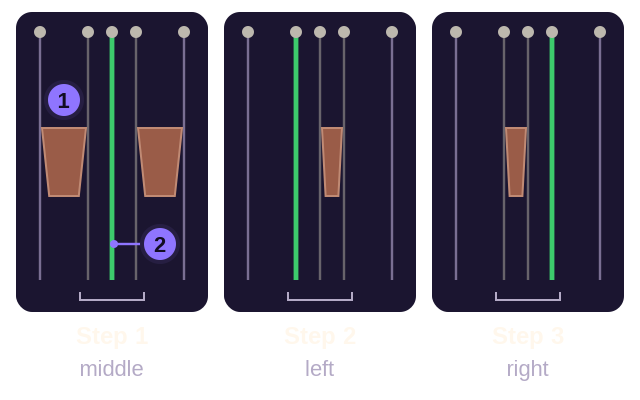
- A rubber wedge goes between two neighbouring strings and mutes both.
- Only the free string (green) sounds. That is the one you tune.
For a note with three strings: first the middle one (sides muted), then the left, then the right. Finally take the wedges out and play the note: if the sound is steady, it's done; if it wobbles ("wah-wah-wah"), one string has drifted slightly.
Step 7. The order: from A4 up, then down
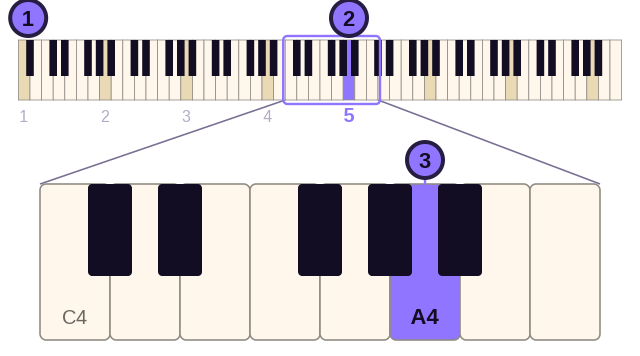
- The leftmost key of the piano is an A (A0). After it, A comes back every 7 white keys.
- Count the fifth A from the left: that is A4, slightly right of the middle of the keyboard.
- Check: an A is the white key between the second and third black keys of a group of three.
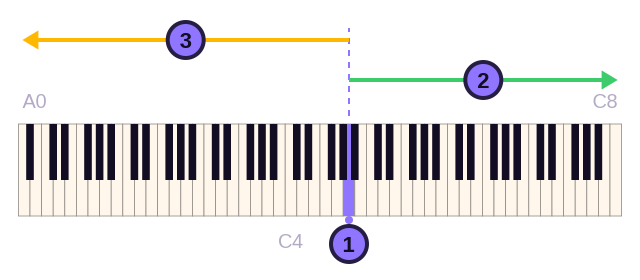
- Start with A4, the A above middle C.
- Then every key upwards in turn, white and black, to the very top (C8).
- Go back to A4 and work down to the very bottom (A0).
Step 8. The second pass
The total tension of a piano's strings is about 18–20 tonnes. When you change the tension of hundreds of strings, the frame flexes a little and the first notes drift. So go over the whole piano once more. The second pass is quick: the corrections are small.
Take breaks. A tired hand jerks the lever, and a jerk easily knocks a string you have already tuned.
Why a guitar tuner won't do: stretch
Piano strings are thick and stiff, so their overtones sound slightly sharper than "ideal". Tune every note strictly by the formula and the treble will sound flat and the bass muddy. So tuners stretch the octaves a little: the bass goes down, the treble up — up to +20…+35 cents at the top and −10…−30 in the bass. Exactly how much depends on the strings of the instrument. In detail, with an interactive chart: "Stretch tuning".
What the app does
Foxtune: Piano Tuner walks you through this plan: survey, pitch, stretch, tuning in two passes and a final check. The tuner measures the overtones of every string and computes the stretch for your piano. Free: the survey of all 88 keys, the plan, the illustrated guide and the tuner in the two middle octaves. Pro opens the tuner on the whole keyboard, step-by-step mode, the measured stretch and pitch raise.
More guides: tuning an old piano, a piano out of tune after moving, tuning by ear without a tuner.