Tuning a piano takes two tools: a tuning lever that turns the pins, and mutes that silence the strings you are not tuning, so that only one sounds. Here is how to choose them — and why nothing else can stand in for them.
The tuning lever
Also called a tuning hammer: a lever with a head that fits over the tuning pin — the steel pin that holds a string. Turn the pin and the string's tension and pitch change.
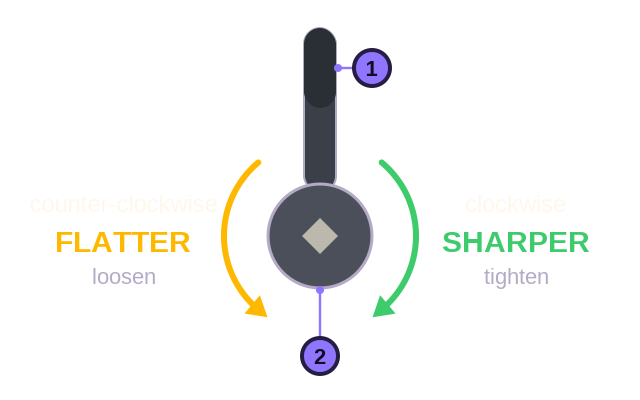
- The handle. Hold it roughly upright, "at 12–1 o'clock". Then moving the handle right turns the pin clockwise (sharper), and left counter-clockwise (flatter).
- The head. Push it onto the pin all the way: it must sit tight, without play.
Which tip
- A star tip has eight points inside. It fits a square pin in two positions, so it's easier to set the handle at a comfortable angle. It fits the pins of most uprights and grands.
- The tip number is its size. Most often you need number 2, which fits the pins of most pianos. Pins come thinner and thicker, so if in doubt, get a lever with interchangeable tips.
- An extension tip helps when the pins sit deep: on some grands and older uprights a standard head barely reaches them.
Which handle
- A simple L- or T-shaped lever will do for a first tuning. It's inexpensive, but a short handle gives you less feel for the pin.
- A professional lever has a long handle and an interchangeable tip. Length gives precision: the pin turns by fractions of a degree, and a long lever makes that easier to feel.
What not to use instead
- Pliers. They hold the pin by its edges, crush it and slip.
- An adjustable wrench. It doesn't sit tight, leaves play and crushes the corners too.
- Sockets from a car toolkit. A round or hexagonal profile sits badly on a square pin: it turns in jerks.
- A drill or screwdriver. Far too coarse: the note jumps by dozens of cents and the pin can slip in the block.
A crushed pin holds the tuning worse, and a real lever may not fit it afterwards. A simple tuning lever costs less than the repair.
Mutes: one string at a time
Most keys have 2–3 strings, each with its own pin. If several strings sound at once, the tuner hears their mix and can't show each one. So the others are muted and the strings are tuned one by one.
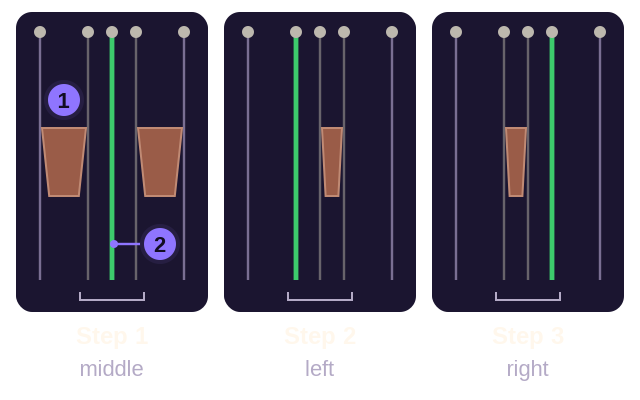
- A rubber wedge goes between two neighbouring strings and mutes both.
- Only the free string (green) sounds. That is the one you tune.
Kinds of mutes
- Rubber wedges — the main tool. They come with a wire handle (easy to pull out) or without. For a first tuning 2–3 are enough.
- A felt temperament strip mutes the side strings of a whole section of the keyboard and leaves the middle ones free. Technicians tune the middle strings in a row this way, then bring the side strings to them.
- Grand piano mutes (Papps wedges) are narrow wedges that go between the strings of one note. On a grand the strings lie flat, and upright wedges hold less well.
How to place them
For a note with three strings:
- Mute both side strings — tune the middle one.
- Free the left one — tune it to the middle.
- Free the right one — tune it too.
- Take the mutes out and play the note. If the sound is steady, it's done. If it wobbles ("wah-wah-wah"), one string has drifted slightly.
For a note with two strings, put a wedge between one of them and a string of the neighbouring key. Single-string bass notes need no muting.
On a grand the left pedal helps: the action shifts and the hammers strike only two of the three strings, so you need fewer mutes.
Anything else?
- A piano tuner — one that includes the stretch of the tuning. Why a plain tuner won't do: "Stretch tuning".
- A torch: it's dark inside a piano, and you need to find exactly the right pin.
- Glasses: a breaking string can whip.
Next, the tuning itself, step by step: "How to tune a piano yourself".