Almost every piano is out of tune after a move. It's rarely the movers' fault: the instrument is simply getting used to a new room. Here is what to do — and what not to do too soon.
Why moving puts a piano out of tune
A piano is mostly wood: the soundboard that amplifies the sound and the pinblock that holds the tuning pins. Wood takes up and gives off moisture, and as it swells or shrinks, the tension of the strings changes. A new room means a new temperature and humidity — so the tuning drifts, sometimes noticeably.
The bumps of the journey matter less. A sound piano survives a careful move without real damage; if keys stick or something rattles, that's a separate problem for a technician.
Wait 2–3 weeks
Don't tune it the day it arrives. The wood needs time to settle into the new climate, and a tuning done earlier will drift again within days. Let the piano stand in its room for 2–3 weeks, then check it.
Choose the right spot
- An inside wall rather than an outside one: steadier temperature.
- Away from radiators, heaters and air conditioning. Hot dry air is the worst for a piano.
- Away from windows and direct sun.
- Steady humidity, ideally around 40–50%. In winter with the heating on the air can get very dry; a humidifier in the room helps.
Then check the tuning
After 2–3 weeks, play the piano and listen:
- does a single note "wobble" (a wah-wah-wah beat)? The strings of that note have drifted apart;
- do octaves sound sour?
- is the whole piano lower than a recording or another instrument?
A tuner shows it precisely. In Foxtune: Piano Tuner the free tuning survey takes five minutes: you play two keys per octave and the app shows all 88 keys and says whether the piano is in tune, the notes have drifted apart, or the pitch has dropped.
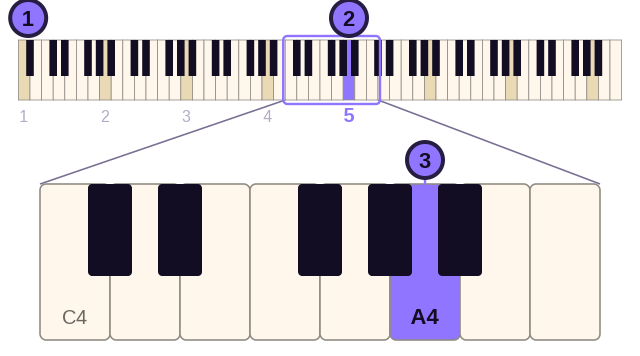
- The leftmost key of the piano is an A (A0). After it, A comes back every 7 white keys.
- Count the fifth A from the left: that is A4, slightly right of the middle of the keyboard.
- Check: an A is the white key between the second and third black keys of a group of three.
Then tune it
If only a few notes have drifted, fix those. If the whole piano has moved, do a full tuning: "How to tune a piano yourself". If it has dropped a lot — more than 15 cents on average — see "Pitch raise".
After a move the piano may keep settling for a while. Check it again a month or two later; a quick touch-up is normal.