Piano technicians tune by ear, and you can learn part of it too. The secret isn't perfect pitch — it's hearing beats. Here is what works by ear, and where a tuner saves a lot of time.
Hear the beats
Play two strings that are almost, but not quite, the same pitch. Instead of one steady sound you hear the loudness pulse: wah-wah-wah. That pulse is called beating. The further apart the strings, the faster it beats; as they come together it slows down; when they are in tune it stops and the sound becomes still and clear.
All tuning by ear is built on this: you turn the pin and listen to the beats slow down and disappear.
You need one reference note
By ear you can make notes agree with each other, but you need one starting pitch: an A 440 tuning fork, a reference tone from a phone, or another instrument that is in tune. Tune A4 to it first — strike the fork, hold it to the piano, play A4 and remove the beats between them.
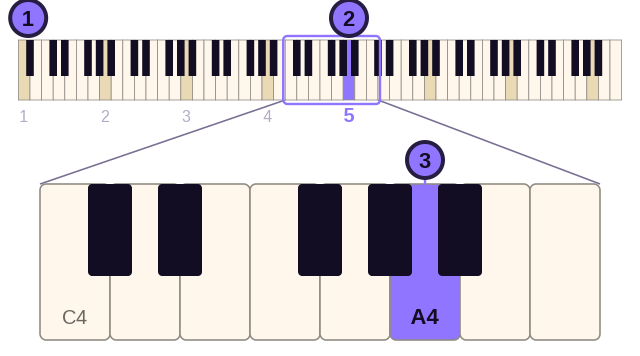
- The leftmost key of the piano is an A (A0). After it, A comes back every 7 white keys.
- Count the fifth A from the left: that is A4, slightly right of the middle of the keyboard.
- Check: an A is the white key between the second and third black keys of a group of three.
Unisons: the easiest part
Most keys have 2–3 strings that must sound exactly alike. Mute all but one with rubber wedges, then free a second string and turn its pin until the beating between the two stops. Then the third. This is what fixes the most common problem — a single note that "wobbles".
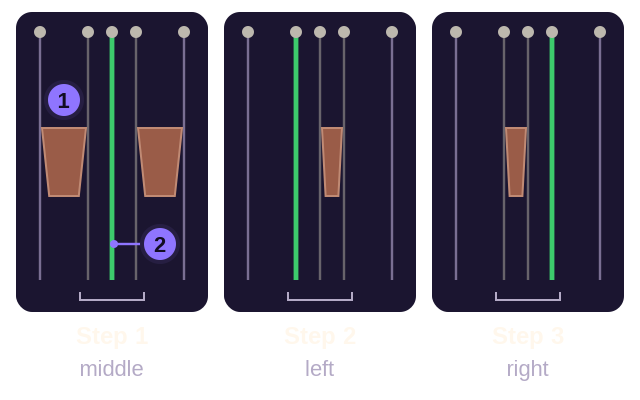
- A rubber wedge goes between two neighbouring strings and mutes both.
- Only the free string (green) sounds. That is the one you tune.
Octaves: by ear, with the stretch built in
Once a note in the middle is right, you can tune the note an octave above it by ear: play both and remove the beats. Here the ear does something a plain tuner can't — it matches the upper note to the slightly sharp second overtone of the lower one, so the octaves come out naturally stretched. That's the reason a piano tuned by ear in octaves sounds right and a piano tuned by a chromatic tuner doesn't. More: "Stretch tuning".
The temperament: the hard part
The notes inside one octave — the temperament — can't be tuned "beatless". In equal temperament every fifth and fourth must beat at a particular slow rate, and every third faster. Technicians set this octave by counting beats per second against a sequence of intervals. It's learnable but takes practice, and small errors spread across the whole keyboard.
That's where a tuner is most useful: set the middle octave or two with a tuner, then do the unisons and octaves by ear if you like.
A practical plan
- Set A4 from a tuning fork or reference tone.
- Set the middle octave with a tuner (or, with practice, by counting beats).
- Tune the unisons of those notes by ear.
- Go up and down the keyboard in octaves by ear, removing the beats.
- Go over everything a second time.
The tools you need: "Tuning lever and mutes". The full procedure: "How to tune a piano yourself".