A piano goes out of tune gradually, so your ear gets used to it and you don't notice. Here are the signs that it's time to check the tuning, and how to do it in five minutes.
Signs you can hear
- A note wobbles. Play a single key in the middle and listen as the sound dies away. If you hear "wah-wah-wah" — waves of loudness — the strings of that note have drifted apart. This is the most common sign.
- Octaves sound sour. Play a C and the C an octave above it together. In tune, they merge into one sound; if you hear beating or a jangle, the octave is out of tune.
- Chords sound like a saloon piano. A major triad in the middle of the keyboard sounds dirty and honky-tonk.
- The piano doesn't match a recording or another instrument. The whole piano has dropped below standard pitch — this happens to instruments that haven't been tuned for a long time.
- Single notes stick out — they sound noticeably higher or lower than their neighbours.
What puts a piano out of tune
- more than a year has passed since the last tuning;
- the heating season has started or ended;
- the piano stands by a radiator, under an air conditioner or next to a window;
- it has been moved to a new home or to another room;
- it gets played a lot: several hours of practice a day put it out of tune faster.
A 5-minute check
By ear
- Play every key in the middle two octaves, one at a time, and listen for a wobble.
- Play a few octaves: from the C below middle C to middle C, from G to G and so on.
- Compare A4, the A above middle C, with a 440 Hz reference tone — from a tuner app, for example. If the piano is clearly lower, its pitch has dropped.
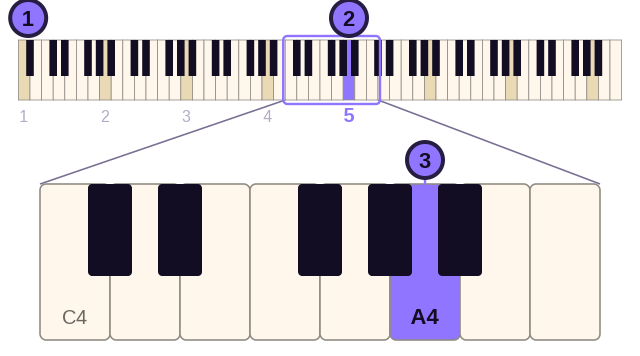
- The leftmost key of the piano is an A (A0). After it, A comes back every 7 white keys.
- Count the fifth A from the left: that is A4, slightly right of the middle of the keyboard.
- Check: an A is the white key between the second and third black keys of a group of three.
With a tuner
Play two notes in every octave, from the very bottom to the top, and write down how many cents each one is off. A cent is a hundredth of a semitone: in a single note the ear notices deviations of 3–5 cents, and between two notes sounding together even smaller ones.
| What you see | What it means |
|---|---|
| Almost every note within ±5 cents | The piano is in tune |
| Notes scattered by ±10 cents or more | The notes have drifted apart — it needs a tuning |
| Below −15 cents on average | The whole piano has dropped in pitch |
| Below −40 cents (A4 under 430 Hz) | It needs a pitch raise, ideally by a technician |
A plain chromatic tuner isn't much use for this: on a piano the treble and bass are deliberately stretched a little, so such a tuner will say "out of tune" even on a well-tuned instrument. More: "Stretch tuning".
In the app
In Foxtune: Piano Tuner this is the "Tuning survey", and it's free. First play A4, then two more keys in every octave as prompted. The app shows a chart of all 88 keys with the stretch taken into account and gives a plain verdict: "in tune", "the notes have drifted apart", "the pitch has sagged" or "better call a technician". Surveys are saved, so it's easy to compare "before" and "after".
What to do next
- One or two notes have drifted — fix them; it takes 15 minutes. You need a tuning lever and a couple of mutes: "Tuning lever and mutes".
- Notes have drifted apart across the keyboard — it needs a full tuning: "How to tune a piano yourself".
- The whole piano has dropped — you can tune it to itself at its current level or raise it to 440 Hz: "Pitch raise".
- Tuning pins turn too easily, strings break, keys stick — that's a repair. Call a technician.